Coherence Loss: The AI Opportunity Hiding in Plain Sight
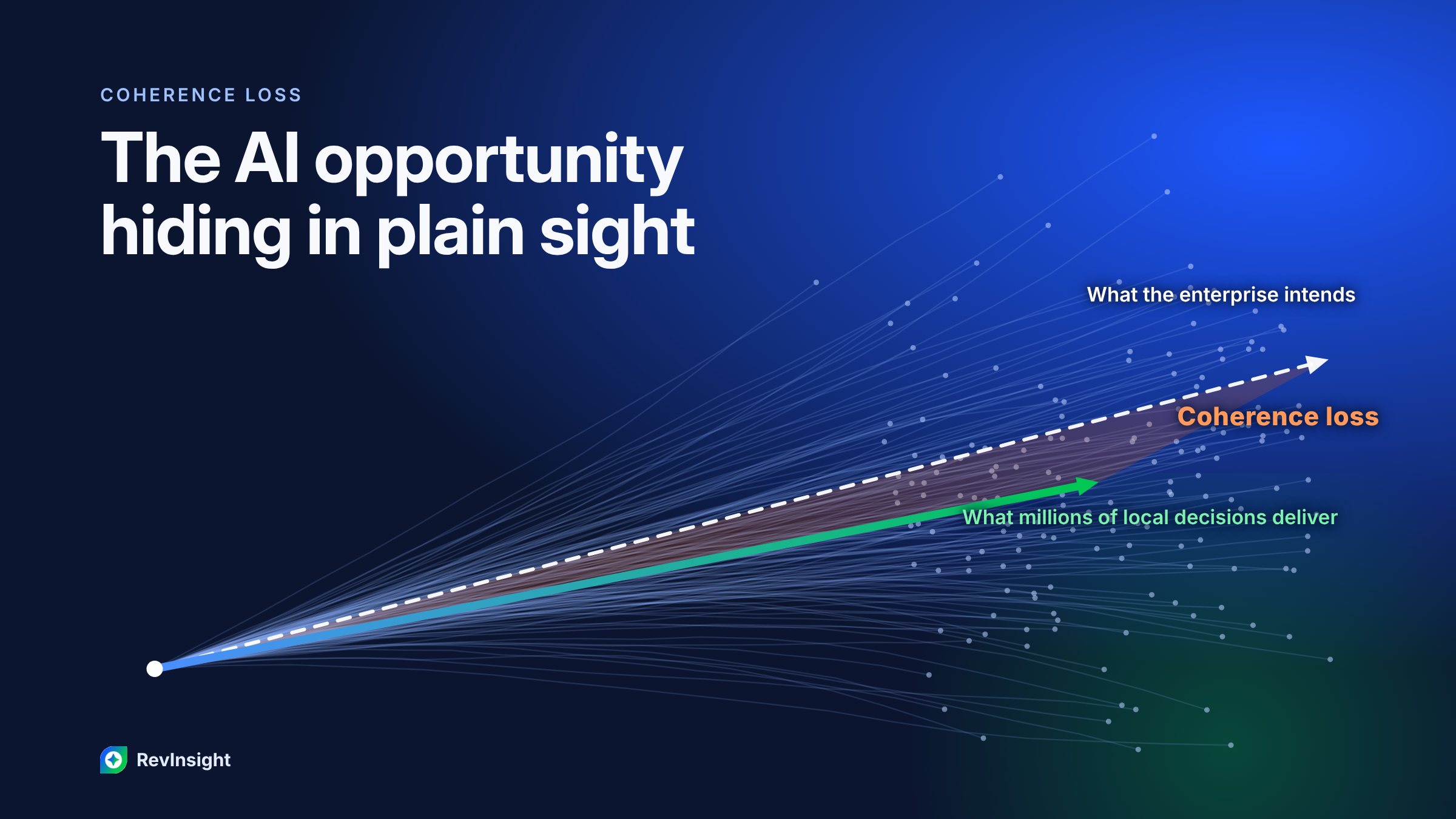
AI’s biggest economic opportunity may be in reducing the gap between organizational intent and distributed action. The AI value gap is not a technology…


The reason isn’t the model — it’s the language.
Engineering has universal verbs and nouns: “deploy,” “refactor,” “merge.” Everyone speaks the same language. And that’s exactly why AI-powered development workflows work so well. Anthropic, for instance, has done impressive work here — not just the model, but the skills and workflows around it.
Here’s the trap: people assume that same workflow can be transplanted into the enterprise. It can’t.
Every business has its own verbs and nouns. A “deal” at one company isn’t the same as a “deal” at another. An AI tool built for “deal management” assumes a linear pipeline. But at a consulting firm, a “deal” might loop through three partners, two committees, and an informal hallway conversation before it’s real. The generic verb doesn’t capture that.
This creates a gap on both sides. Technical teams build AI workflows using code-centric abstractions that don’t map to how the business operates. Business and sales teams know what they need intuitively — but no one has ever asked them to articulate it as structured verbs and nouns.
The real unlock isn’t a better model. It’s helping each organization discover and define its own verbs and nouns — then using stochastic models to observe how the business actually operates, extract its domain language, and teach AI those skills. Not generic skills. Your skills.
That is the real software opportunity. Not another copilot bolted onto a toolbar — but a system that learns how your business speaks and works alongside it in that language.
This will demand deep engineering on software platforms built for these use cases. The SaaS companies that evolve to solve this — or the new ones that are born from it — will define the next era of enterprise software.