Coherence Loss: The AI Opportunity Hiding in Plain Sight
AI’s biggest economic opportunity may be in reducing the gap between organizational intent and distributed action. The AI value gap is not a technology…

The way we think about organizing work has changed four times. Each change wasn’t a refinement of the previous model. It was a response to a wall the previous model couldn’t get past. We’re inside the fourth change right now. Most organizations haven’t noticed yet.
This is the standard design. Group people by what they know how to do. Sales here. Finance there. Engineering over there. Hire specialists, cluster them, let expertise compound within each function.
This model underpins most corporate structures today. The department is still the primary unit of organizational identity for most people. It works up to a point.
The point it doesn’t work past: value doesn’t get created inside a single department. It gets created across them. The departmental model has had to evolve, but it’s still recognizable as the “bones” of the enterprise.
Limitation: Intelligence trapped in silos.
Value doesn’t live inside departments. It flows across them. Supply chains. Customer journeys. Order-to-cash. The real work of a business is a sequence of handoffs, and the departmental model was blind to all of it.
The slow burn of Kaizen exploded into “process thinking” and gave rise to BPR, ERP, Six Sigma. It reoriented companies around multi-department and multi-enterprise processes instead of functions. That was real progress.
But processes had to be grafted onto departments that didn’t disappear. The result was a hybrid nobody designed: silos threaded together by process owners, program managers, and RACI charts. The cognitive load on management exploded. Someone always had to hold a “big picture” in their head.
CRMs. ERPs. Project management software. Every generation of tooling was built to manage that cognitive load. None of it resolved the underlying tension. The department and the process were in permanent friction, and management was the buffer between them.
Limitation: Cognitive overload at every handoff.
If what organizations actually do is make decisions (where to invest, what to prioritize, who to sell to, how to respond), then the decision should be the right unit of analysis. The premise was sound. The model got stuck in the corporate dance of centralization/decentralization, overlay/staff functions, data/analytics/decision-support, and added coordination overheads.
James March spent decades studying why. His conclusion is unsettling. Organizations aren’t primarily decision-making systems. They’re rule-following systems. Most behavior isn’t driven by calculating consequences, it’s driven by a logic of appropriateness: what does someone in my role do in a situation like this? That question gets answered automatically, institutionally, without deliberation. It’s not avoidance. It’s how organizations actually function at scale.
Formalize the decisions and you don’t expose the organization, you disrupt it. The informal fabric of roles, rules, and norms is load-bearing. It’s also, as March observed, loosely coupled by design: solutions and problems connect opportunistically, not hierarchically. Tighten that coupling by forcing decisions into explicit frameworks and the whole system stiffens. Decision processes, March noted, are often only incidentally about making decisions. They distribute legitimacy. They assign accountability. They perform rationality for an audience. Strip that out and you don’t get clarity. You get paralysis and politics.
March didn’t prescribe abandoning decision frameworks, he explained why they keep failing. The prescription follows from the evidence: an organizational model built on what organizations structurally resist is not a design. It’s a recurring mistake. The deeper problem is that organizational decision-making is structurally defended against exposure. Not because people are irrational, but because the informal machinery works, and formalization breaks it.
Limitation: Traditional “human-first” organizations use paralysis and politics to defend against decision formalization.
The fourth model changes what carries the intelligence.
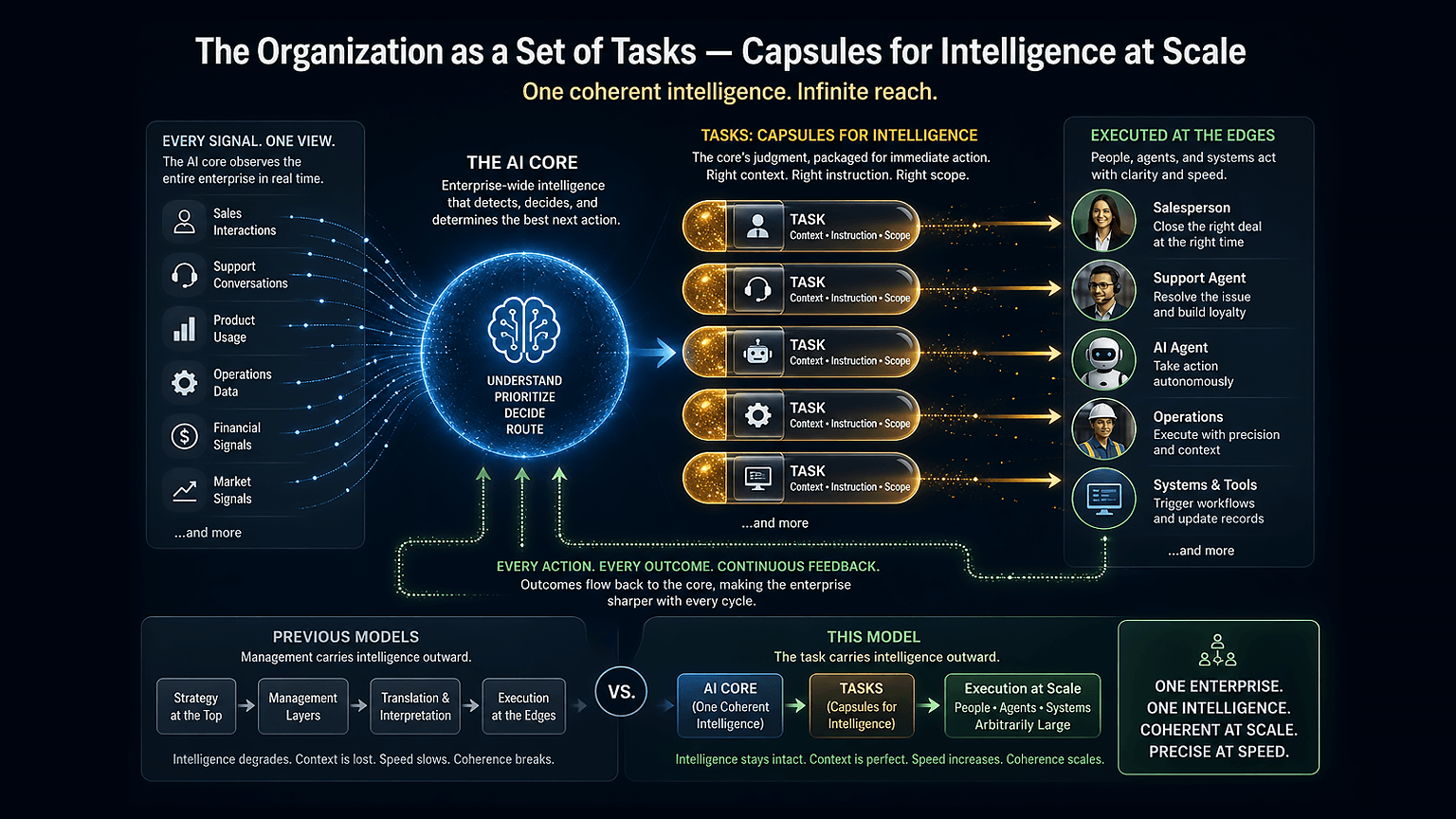
Every enterprise faces the same structural problem: the larger and faster it operates, the harder it becomes to act as one. Speed lives at the edges: in the hands of individual salespeople, support agents, and operators making judgment calls with incomplete context. Coherence lives at the center: in strategy documents, training programs, and management layers perpetually racing to catch up with what’s happening on the ground. Enterprises have always been forced to choose between the two. That is the coherence bottleneck, and every previous organizational model hit it.
AI allows us to change the terms of this tradeoff entirely, and the AI-First enterprise architecture bypasses the March marsh. In an AI-first organization, there is a core: an enterprise-wide intelligence that watches every interaction across every silo simultaneously, detects the signals that matter, and routes each situation to its optimal response. That core is where coherent intelligence lives. Building that core requires a unified data architecture and an enterprise context model: a genuine engineering challenge, not a given. The architecture that makes this possible is described in The AI-First Enterprise. The next problem is how to get that central intelligence to act at the edges, reliably and at scale.
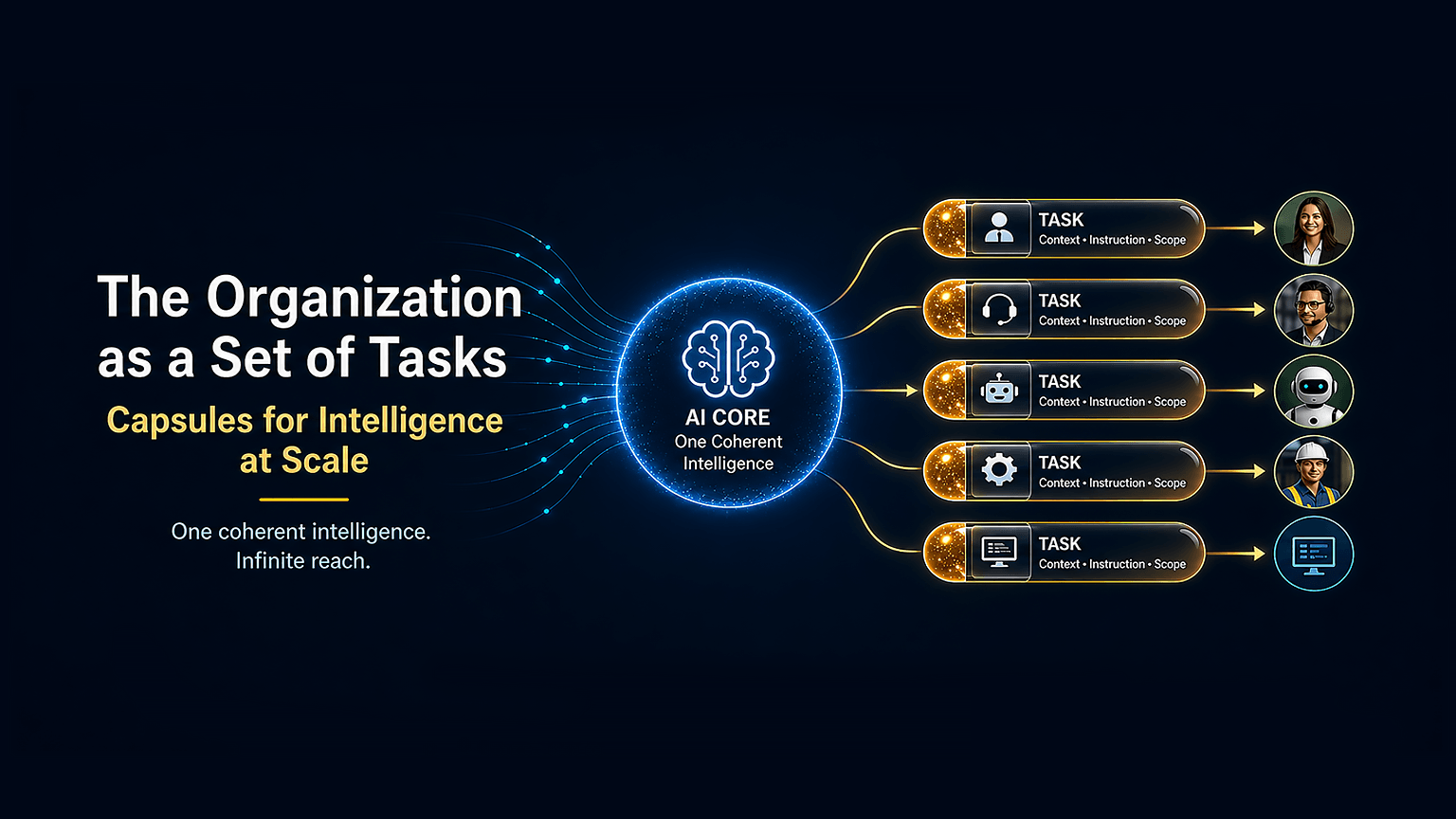
The answer is the task. Think of it like a capsule in medicine: the active ingredient is the intelligence, the capsule makes it work. A task packages the AI core’s judgment into something a person or an agent can act on directly: the right context, the right instruction, the right scope. No cognitive overhead imposed: the recipient executes.
This is what makes the model scalable in a way none of its predecessors were. The AI core doesn’t need to grow linearly with the organization. It dispatches tasks to people, to agents, to other systems. An arbitrarily large workforce, human and automated, becomes the delivery mechanism for a single coherent intelligence. The task capsule is what makes that possible.
Previous models required managers to carry intelligence outward. This one doesn’t. The task carries it. For the first time, it is possible to build an enterprise that acts as one: coherent at scale, precise at speed.
The task encapsulates intelligence, drives actions at enterprise scale.
The organizational theory literature raises legitimate questions about any new organization design and enterprise architecture. Each objection is worth engaging directly.
The task-capsule isn’t the whole model, it’s the base layer. Tasks encapsulate the Procedural Intelligence that handles the known, the repeatable, the specifiable: situations covered by playbooks that institutionalize expertise and improve continuously. But the architecture layers Situation Awareness and Emergent Intelligence on top of it. Situation Awareness monitors the organization’s ecosystem, locates hotspots, and detects anomalies that fall outside any existing playbook. Emergent Intelligence adapts in response to patterns the core hasn’t seen before. The trigger is the absence of a matching playbook: when Situation Awareness detects a signal that no existing playbook covers, it surfaces that signal to human judgment: the system knows what it doesn’t know. Front-line judgment isn’t replaced, it’s the capability that is stimulated by the situation awareness feeds and drives the emergent layer. See: Intelligent Behaviors, Situations, and Systems and A Mind Map of Decision Intelligence. Enterprises that don’t operate precisely and intelligently in known situations are hamstrung in dealing with emergent challenges. The task gives people the context to exercise better judgment on a routine basis, the organization gets the muscle-mass for its fundamental activities, and the feedback loop is what makes the system learn.
The task-capsule is not a Taylorist task. A Taylorist task strips context to extract repeatable motion. This task carries context specifically to enable and elicit judgment. The person receiving it knows why it matters, what signals prompted it, what a good outcome looks like, and what latitude they have. The capsule is the scaffolding for judgment, not a substitute for it. Drucker was right that knowledge work requires judgment. The capsule is designed to make that judgment better-informed and better-directed — not to eliminate it. Actors (people, automata, equity-traders, etc.) must react to the direction provided by the core in the context of the real world they work in. They observe, they have constraints, and that’s why the action-requests are only indirectly linked to the action. The actor is task-directed to do the action in its own context. The actor can act successfully, unsuccessfully, or partially. If the action can be perfectly executed by the core it will not be formulated as a task, it will simply get done as an algorithm performing a spec-execution task See: AI as an Acceleration of Human Civilization.
Correct that the AI core is controlled by settings made by people, and those people are the organization’s real power centers. But there’s a structural difference from the informal power dynamics Pfeffer describes: these settings are in software. The core and its agents execute with precision and leave a complete auditable trail: what was detected, what was decided, what was done. That trail is available to the organization’s leadership or its Board of Directors on demand. This directly addresses the Principal-Agent problem that plagues traditional organizational hierarchies, where the gap between stated policy and actual behavior is largely invisible to principals. In an AI-first organization, that gap can be made transparent at any time. It doesn’t eliminate power, but it changes its character from opaque to accountable. See: The AI-First Enterprise.
The task-capsule model isn’t hub-spoke orchestration-by-LLM. An LLM-based hub-spoke system decomposes an incoming question and routes fragments to worker models, burning tokens figuring out decomposition, losing coherence at every handoff. The AI core does something different: it matches observed signals to pre-built playbooks and dispatches a task with full context already assembled. The decomposition problem is solved at playbook-design time, not at runtime. The hub’s cost comes from figuring out how to split work it has never seen before. The AI core’s cost comes from pattern-matching signals it has been built to recognize: a classification problem, not an on-the-fly decomposition problem. Krishnan’s task-shape table confirms the distinction: tasks requiring “one global state, many invariants” favor solo or central architectures, not markets. Enterprise operations are exactly this shape, so the AI core beats markets when the decision is to select the right assignee. The core classifies tasks as spec-execution, spec-following, and spec-making (see AI as an Acceleration of Human Civilization). It does the spec-execution jobs itself (solo topology), and allocates spec-following and spec-making jobs to the right person or external agent. The assigned agent may be an external market, but in this formulation it acts as a spoke of the organization’s hub. Since the AI core does both task-allocation and solo-execution of spec-execution tasks, the organization topology is seen to be hub-spoke because people and external-agents function as spokes.
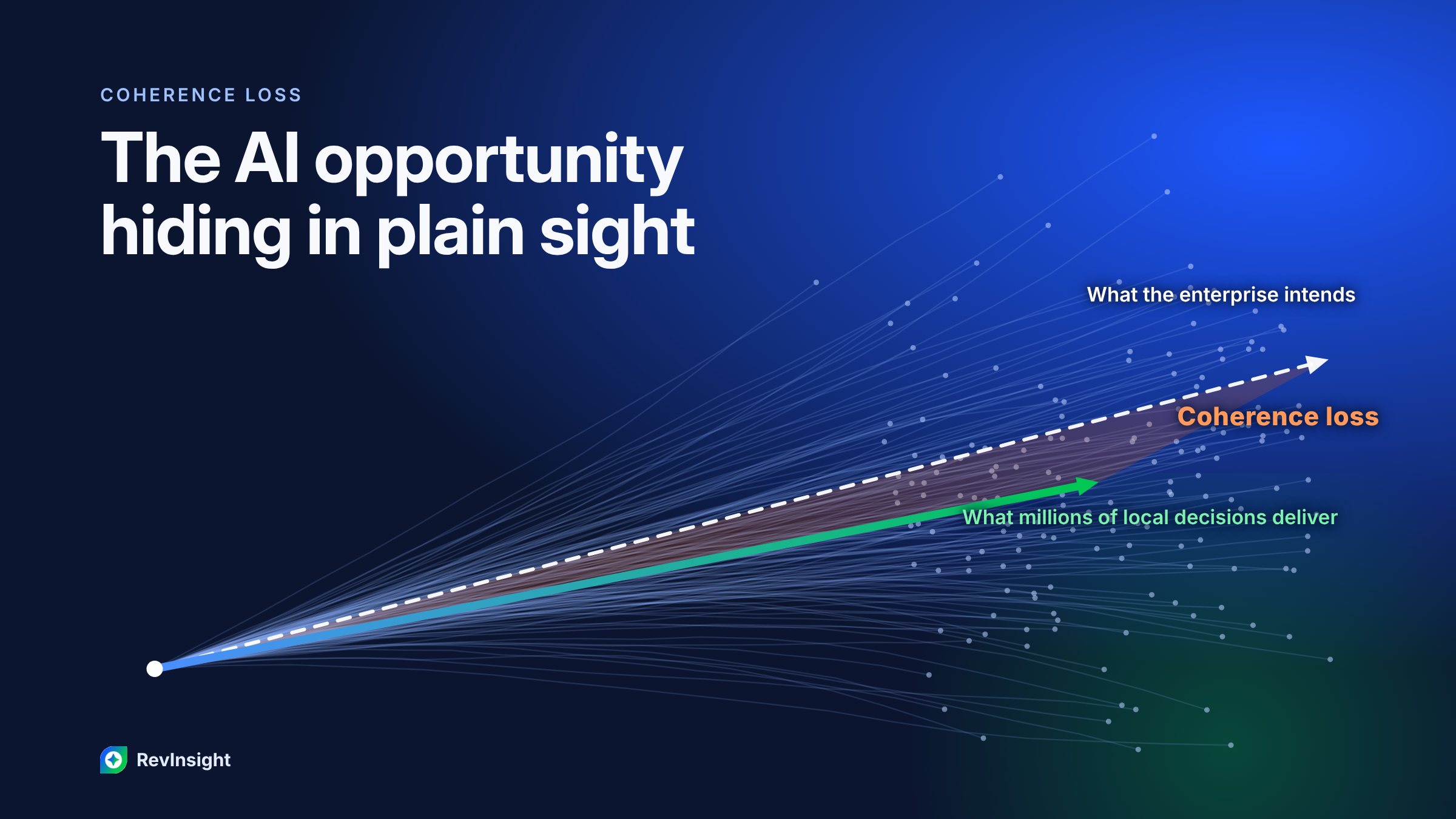
The departmental model called it silos. The process model called it cognitive overload at handoffs. The decision model called it paralysis and politics. Different symptoms, same underlying condition: intelligence concentrated in one place couldn’t reliably reach the people who needed it to act. That is the coherence problem. Every previous organizational model hit it. Solved some of it and left the remainder as management workload. None of them named it clearly enough to solve it.
Naming it matters because the solution follows directly from the diagnosis. Coherence isn’t an org chart problem or a governance problem. The AI core maintains coherence, and then it’s a delivery problem.
The task solves it. Not because it simplifies the demands of intelligence behaviors, but because it packages it. The AI core maintains coherence. The task delivers the right data at the right time to the right actor: to a person, to an agent, to a million of them simultaneously.
Previous models required management to carry intelligence outward. This one doesn’t. The task carries it. For the first time, it is possible to build an enterprise that acts as one. Not just a smarter organization. A coherent one that can act at enterprise scale.