Systems of Tiered Control Loops
The closed-loop framing of enterprise AI is a good starting point. But it isn’t the ending point: what happens when you have myriads of…


Every enterprise faces the same structural problem: the larger and faster it operates, the harder it becomes to act as one.
A single person can filter every interaction through a consistent set of priorities and judgment, but cannot scale. A thousand people provide scale at the cost of coherence. Enterprises have been forced to choose: respond quickly and locally, or respond coherently and slowly.
Speed lives at the edges, in the hands of individual salespeople, support agents, and operators making judgment calls with incomplete context. Coherence lives at the center, in strategy documents, training programs, and management layers perpetually racing to catch up with what’s happening on the ground.
The result is a predictable tradeoff. At the smallest scale, one person filters every interaction through disciplined, structured attention. Precise but not scalable. At the largest scale, millions of trained people, thousands of processes, and layers of systems attempt to act in concert. That’s scalable, but coherence becomes its own full-time problem, absorbing entire cohorts of people just to maintain alignment.
Across the spectrum, enterprise coherence has always been traded against response speed and optimality. It was sufficient to be responsive. It was never possible to be consistently optimal.
AI changes the terms of this tradeoff entirely.
The coherence bottleneck was an accepted cost of doing business. AI makes it feasible to solve by introducing a new kind of participant in enterprise operations: one that can observe at scale, reason in context, and act with consistency across every interaction simultaneously.

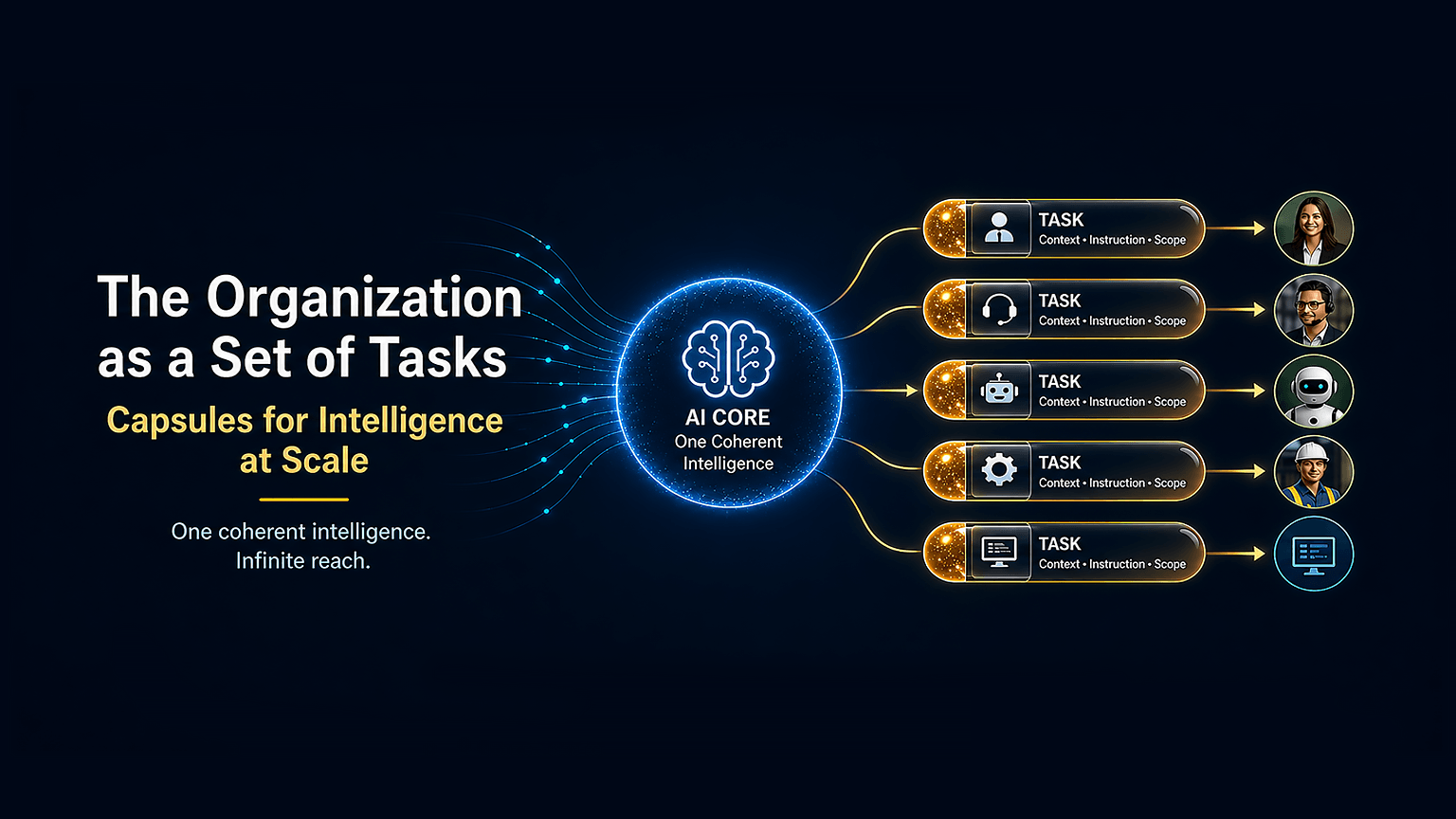
An AI-First Enterprise filters its interactions with the world through AI first. Not as an assistant layer on top of existing operations, but as the primary mechanism through which the enterprise observes, decides, and acts. This requires three interlocking capabilities working as an integrated AI-First System.
These three layers of the system are synergistic and inseparable. The coherence layer feeds the agents. Agents ensure intelligent action at every touchpoint. The workforce operates with the full support of enterprise intelligence for every task. This is architecturally distinct from point solutions, copilots, and agent toolkits: an integrated intelligence system, not a collection of AI features.
The shift this AI-First system architecture enables is a leap or step-change for the enterprise organization architecture. The research makes the stakes clear.
McKinsey finds that when AI eliminates coordination as the bottleneck, product cycles compress and customer capture accelerates in ways no bolt-on productivity gain can match. Gartner makes the architectural implication explicit: the AI-First enterprise is not one where AI assists humans in workflows, but where AI orchestrates workflows that humans participate in. The inversion matters. Andreessen Horowitz observes that this inversion is already extending function by function, systematically taking over the connective tissue of enterprise operations: the coordination, routing, prioritization, and follow-through that consumed enormous human capacity and introduced variance. Sequoia draws the economic conclusion: when the marginal cost of that connective tissue approaches zero, the unit economics of AI-First enterprises become structurally incomparable to those running on legacy architectures.
Enterprises with Bolt-on AI on legacy architectures will improve. They will close tickets faster, generate proposals more quickly, and surface insights that previously required analyst time. These are real gains. But improvement and step-change are not the same thing. The bolt-on enterprise gets better at operating within its fractured architectures. The AI-First enterprise operates from a different architecture entirely, one where coherence is structurally built-in.
The window to make this choice is open now. You can be AI-First at inception, or become AI-First by transformation. The window closes rapidly after AI-First enterprises start to disrupt your niches.
Adding bolt-on AI to a pre-AI systems landscape is not a path toward AI-First. The gap between these two paths is not a gap in tools or in ambition. It is a gap in what the enterprise is built to do. And that gap does not close by adding more features to a foundation that was never designed for coherence.
For the first time, it is possible to build an enterprise that acts as one: coherent at scale, precise at speed, enabling its people to execute in alignment and innovate with rapid enterprise leverage. That is not an incremental gain. It is an entirely new kind of enterprise: one that, for the first time, can act as one.