Systems of Tiered Control Loops
The closed-loop framing of enterprise AI is a good starting point. But it isn’t the ending point: what happens when you have myriads of…

AI’s biggest economic opportunity may be in reducing the gap between organizational intent and distributed action.
AI is already a commercial success wherever the task is bounded. Phones unlock with a face, payments are screened for fraud in milliseconds, developers write code alongside assistants. Legal, compliance, and marketing teams draft and review in a fraction of the time. In each case the task is well defined, the output can be checked, and someone owns the result.
The disappointment is concentrated elsewhere: in enterprise programs that promise to move margins. In many enterprises, the CFO’s question is increasingly difficult to answer: where did the value from AI go? Targeted tasks got faster, but enterprise gains were not commensurate. Robert Solow named the paradox in 1987: “You can see the computer age everywhere but in the productivity statistics.” Productivity rose only in the late 1990s, after firms reorganized around the computing innovation: Michael Hammer’s call to “don’t automate, obliterate” and the ERP systems that made records coherent across silos. But redesign at that scale also brought rigidity and inscrutable complexity, and by Hammer and Champy’s own estimate, most reengineering efforts fell short of their goals. This time, however, the statistics are already moving. US productivity growth has risen from 1.5 percent a year in the 2007–2019 cycle to about 2 percent since 2019, in line with its long-run average of 2.1 percent since 1947. Productivity gains are concentrated in the most AI-exposed industries, which account for 40 percent of the recent gains with 16 percent of the hours, but labor productivity growth has declined in the rest of the economy since peaking in 2023. The exposure index scores how readily AI could perform an industry’s tasks: in effect, how much of its work divides into bounded tasks. Ajay Agrawal, Joshua Gans, and Avi Goldfarb made a version of this case in Power and Prediction: AI pays off when the system is redesigned around it, not when point solutions are added to an unchanged one.
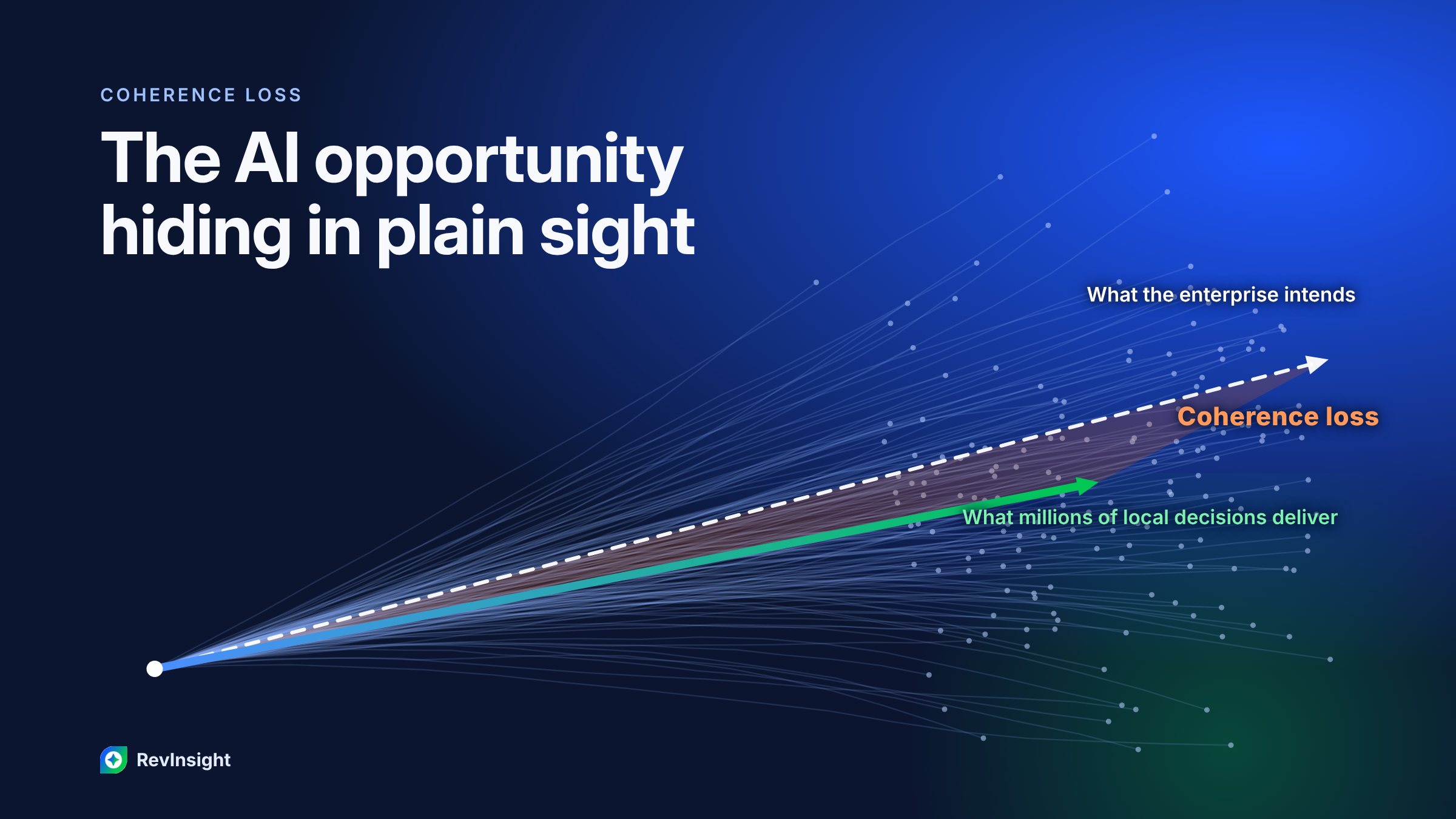
The industry pointed AI at productivity, and it gave speed without velocity. The problem is incoherence. The value is not just lost in how fast people work. It is lost between what the enterprise intends and what millions of distributed decisions cause. We call that leak coherence loss, and the pernicious Principal-Agent Problem is one of its main causes. Like the cost of poor quality before the quality movement, it hides in plain sight, mistaken for the cost of doing business.
The industry’s prevailing answer to failing AI pilots is to govern the agent. Writing in OR/MS Today, Haluk Demirkan cites an MIT study finding that 95% of GenAI pilots yield no measurable value, and Gartner’s prediction that more than 40% of agentic AI projects will be canceled by the end of 2027. His remedy is a thoughtful one: trace each agent’s reasoning and tool calls, observe it in production, and score it on service metrics. That is necessary. But it governs the agent, not the enterprise. A perfectly traced agent can still faithfully serve the wrong objective.
The transformation we need is from opaque, distributed agency to computationally governed agency: purpose, decisions, and actions represented in software, tested before they act and audited after, whether a person or a machine does the work. Enterprises use systems of record, systems of engagement, systems of observation, action, decision, and agents. ERP made the enterprise coherent in its records, not in its consequences. What they lack is a system of consequence that connects organizational intent to decisions, decisions to actions, actions to outcomes, and outcomes back to the policies that produced them.
A system of consequence does not merely record what happened or recommend what should happen. It makes the consequences of distributed decisions visible, attributable, learnable, and actionable. It turns the enterprise from a collection of agents executing locally understood policies into a system capable of continuously testing, evaluating, and improving those policies. That is the opportunity AI creates for the enterprise.
On the concept of “agent”: in economics, an agent is anyone who acts on behalf of a principal: an employee, a manager, a department. In AI today, an agent is software. We use the word in both senses, deliberately. The problem is the same whether the agent is a person, an LLM, or another kind of AI.
For more than four centuries, the corporation has been the engine of economic scale.
The joint-stock companies of the late 1500s let many investors pool capital into ventures no single merchant could finance. Limited liability, which became the norm between roughly 1800 and 1930, extended that logic: an investor could own part of an enterprise without putting all their personal wealth at risk.
The effect was civilizational acceleration. As legal historian Ron Harris notes, the Presidents of Columbia and Harvard viewed the limited liability corporation as the greatest single discovery of modern times, surpassing steam and electricity. From the 1960s, economic analysts of corporation law gave that view its theoretical footing. Harris also shows that the story is longer than limited liability. Corporations flourished for some 250 years before it became standard. What runs through the whole lineage, from the joint-stock company to the modern enterprise, is something deeper: the separation of the capital that owns the enterprise from the people who run it.
That separation let capital scale. It also created a gap.
Adolf Berle and Gardiner Means named that gap in 1932, in The Modern Corporation and Private Property. Michael Jensen and William Meckling priced it in 1976 as agency costs: the cost of monitoring agents, the cost of bonding them, and the residual loss that remains after both. Their insight is easy to miss: the residual loss is an equilibrium, not simply waste. Owners stop paying for oversight when the next dollar of monitoring saves less than a dollar of loss. Lower the price of oversight, and the efficient level of loss falls with it. That is the opportunity this essay is about.
The shareholder cannot decide which customer to call. The CEO cannot review every opportunity. The sales manager cannot supervise every conversation. The decisions that create or destroy value are made by people several layers away from the capital that bears the consequences. The enterprise has owners. But the people who make operating decisions do not bear all the consequences.
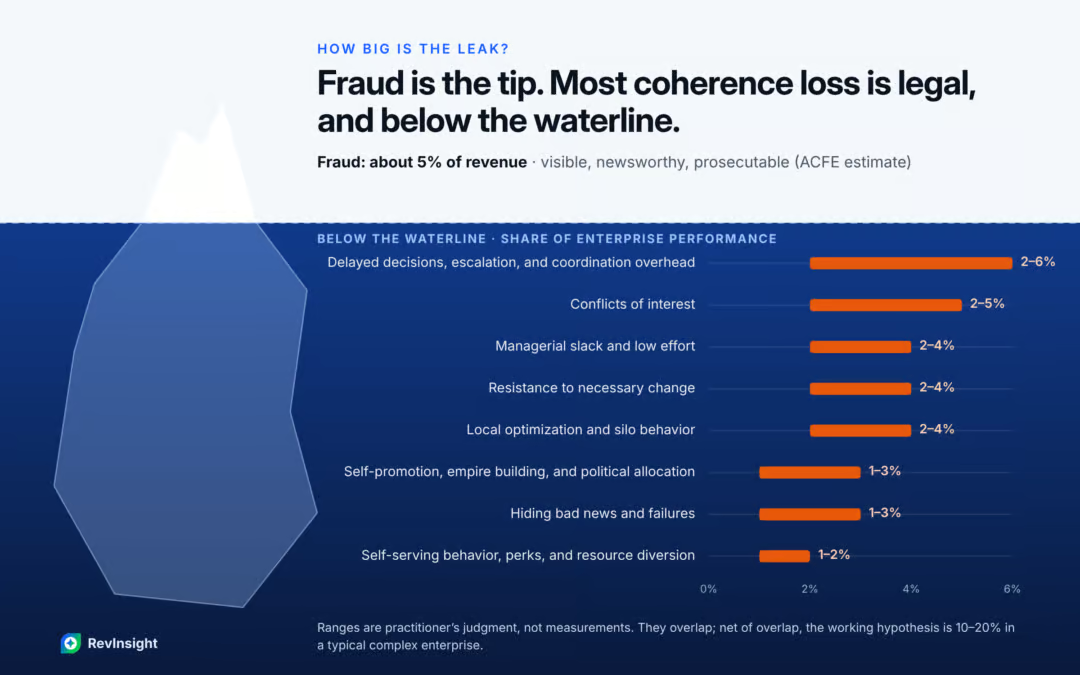
Fraud is the tip of the iceberg: visible, newsworthy, prosecutable. Most coherence cost is invisible:
The Principal-Agent Problem does not need bad people. It just needs different positions in the system:
Nobody commits fraud. Nobody breaks a policy. Everyone acts rationally. But the losses pile up. There is no line on the income statement for “value lost because three departments optimized different objectives.” The loss arrives as lower growth, thinner margins, slower decisions, and failed initiatives.
Not all of this is agency loss; it’s also coordination loss. Agency loss arises when the agent wants something different from the principal. Coordination loss arises when everyone wants the same thing but lacks the information or the mechanism to act as one. Silos and slow escalation often happen among people with identical goals. Jay Galbraith described the mechanism in 1974: as uncertainty and interdependence grow, the information an organization must process outruns what its hierarchy, rules, and plans can carry. Paul Milgrom and John Roberts showed why piecemeal fixes disappoint: complementary practices pay off only when they change together.
In a real enterprise the two are tangled. Agency behavior distorts information and creates room for coordination loss. The combined loss is the coherence loss we named at the outset. Operationally, we define coherence loss as the gap between the value of the best tested policy under the relevant conditions and the value the enterprise realized. This is deliberately an achievable-performance measure, not a claim about an unknowable theoretical optimum. Under comparable conditions, if a tested policy would have produced $X and the enterprise produced $Y, the difference is a performance gap. The simulator checks how much of the gap can be explained by changes in the conditions other than the policy. Say a policy was expected to improve sales by 5 percent in a flat market. The market unexpectedly grew by 3 percent, and sales by 5 percent. The simulator will have to estimate the effect of the policy and may reduce the estimate of achievable performance of the policy.
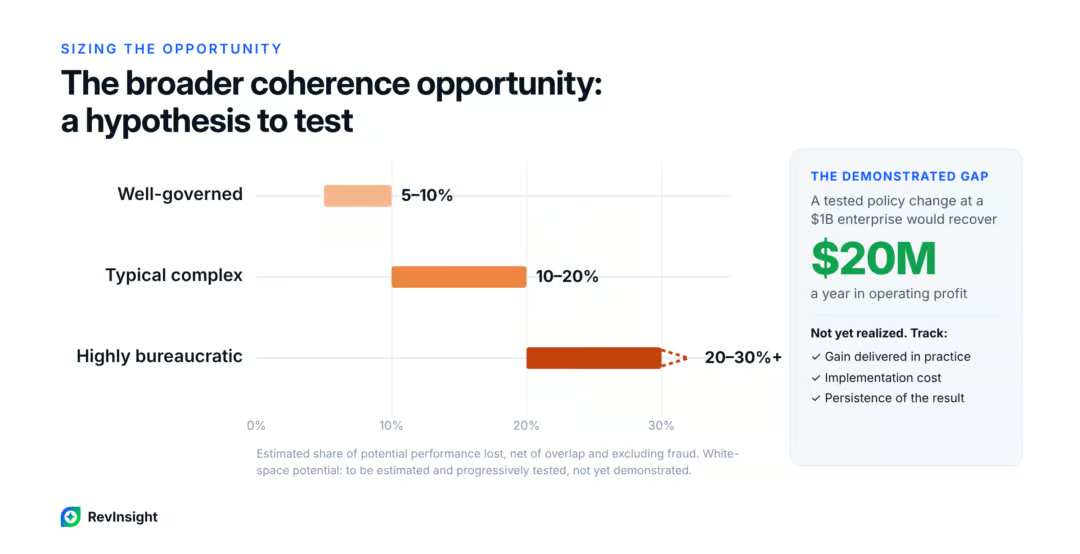
This gives us two distinct quantities. The demonstrated coherence gap is the value difference between a tested policy’s performance under comparable conditions (expected results) and the outcome the enterprise achieved (actual results). The broader coherence opportunity includes losses for which no successful alternative policy has yet been demonstrated. The first can be measured against a tested counterfactual; the second must be estimated and progressively tested. A system of consequence should track both, without confusing demonstrated recoverable value with unexplored potential.
That is why coherence loss must be measured as a continuing empirical process, not treated as a fixed property of an organization. This is the coherence concern described in The AI-First Enterprise; any serious solution must attack both agency and coordination loss.
How large is the loss? No one has measured the total, and adding up the pieces that have been studied would count the same losses twice. But there are indications of scale.
As the iceberg’s visible tip, fraud is the best-measured form of agency loss. The ACFE’s Occupational Fraud 2026 report, drawn from 2,402 cases across 143 countries, reports that certified fraud examiners estimate organizations lose 5% of revenue to fraud each year. That is a survey of expert estimates, as a share of revenue, so it indicates scale rather than measuring it.
Beyond fraud, the list is longer, and most of it is perfectly legal. Here’s a rough sizing of these non-fraud losses, practitioner’s judgment rather than measurements, expressed as a share of enterprise performance, largest first:
These overlap heavily, so they do not simply add up. Net of overlap, and excluding fraud, our working hypothesis is that 5–10% of potential performance leaks away in a well-governed enterprise, 10–20% in a typical complex one, and 20–30% or more in a highly bureaucratic one. Treat these as rough-cut numbers in a starting taxonomy for measurement, not independently estimated components of a validated total.
The management practices research of Nicholas Bloom, Raffaella Sadun, and John Van Reenen shows how much of the performance gap between firms comes from how they are managed: differences in management practices account for about 30% of the differences in total factor productivity across firms within a country. These numbers are not estimates of measured agency loss. They are a falsifiable sizing hypothesis to test against your own numbers. The point is not that “the answer is 15%”, it is that coherence loss is economically material and we should start measuring it.
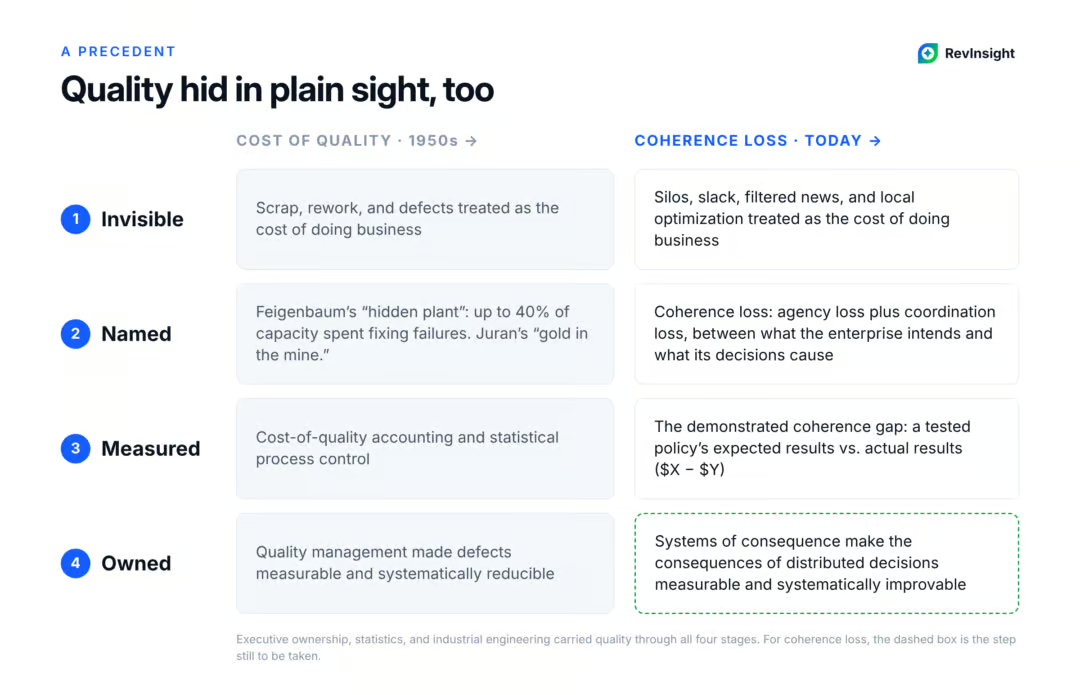
Quality was once invisible in the same way. In the 1950s, scrap, rework, and defects were treated as the cost of doing business, and quality-control departments handled them on a case-by-case basis. Then Armand Feigenbaum gave the loss a name: the “hidden plant”, with as much as 40 percent of a factory’s capacity spent fixing failures. Joseph Juran called it “gold in the mine.” Measurement turned the landscape into an opportunity to be harvested. Executive ownership, statistics, and industrial engineering waged the war and won the prize. Coherence loss stands where the cost of quality stood before that turn: fought piecemeal, through reorganizations, incentive redesigns, and dashboards, because no one owns the whole. Quality management made defects measurable and systematically reducible. Systems of consequence aim to make the consequences of distributed organizational decisions measurable and systematically improvable.
State-owned enterprises (SOE) offer a revealing comparison, because their owners, the citizens, are as diffused as owners can be. The IMF’s Fiscal Monitor (April 2020) found that SOEs trail private firms in the same sectors on productivity, by a wide margin where perceived corruption is high and by about 7% where governance is strong. Railways show how such losses hide. Indian Railways’ share of freight fell from 89% in 1950–51 to 30% in 2011–12 (PRS Legislative Research), while its tonnage rose every decade. Trucks took share from railways everywhere (NITI Aayog / BRIEF), and SOEs carry social mandates that private firms do not, so neither figure measures agency loss. Both are consistent with losses that grow as ownership diffuses and that hide behind metrics that look healthy.
Let’s make it concrete. Suppose a $1 billion enterprise could demonstrate that a policy change would recover $20 million in annual operating profit under comparable conditions. That is a quantified opportunity, not yet a realized gain. The system of consequence would track whether the change delivered that gain in practice, at what implementation cost, and whether the result persisted.
When people think of enterprise AI today, they think of LLMs deployed at the level of the individual agent. A copilot for the seller. An assistant for the manager. An agent for the support rep. Each one makes its user more capable. None of them changes what that user is optimizing for.
A seller with a copilot still optimizes for this quarter’s quota. A department with an agent still protects its budget. A manager with better summaries still decides what news travels upward. AI amplifies the agent. It does not represent the principal. Making every agent smarter does not make the enterprise smarter. It can make an incoherent enterprise faster.
And there is a second trap. Replace a human agent with an autonomous LLM agent, and you have not removed the Principal-Agent Problem. You have created a new one. The principal must now ask: What is the LLM optimizing? What authority does it have? Why did it act? What happened afterwards? Can we learn from its mistakes?
“LLM + tools + autonomy” does not answer those questions; it makes them harder to answer. Noam Kolt, drawing on agency law and economics, shows that LLM agents raise the familiar problems of information asymmetry, discretionary authority, and loyalty, and that the conventional fixes, incentives and monitoring, may not hold at machine speed and scale.
The answer is not to swap a human agent for an LLM agent. It is to use the kind of AI that has run operations for decades: the optimizers and simulators that are used for supply-chain planning, factory scheduling, airline revenue management, truckload dispatch, etc.
Governed agency is a design problem, and it requires explicit decision-making processes and algorithms, the discipline of Operations Research (OR), and explicit enterprise ontology and semantics, which are spread across many professional communities and which OR modelers already practice whenever they formulate a model.
Enterprises have tried hierarchy, incentives, contracts, dashboards, and audits. Each helped, but none closed the gap, because each still relied on intent traveling through people.
In model-driven operations such as factories and supply chains, intent is already infused into execution. Why not for the entire enterprise?
In most other functions, the path runs through hierarchy and culture. Purpose becomes strategy, strategy becomes departmental goals, goals become manager decisions, and decisions become employee actions. Culture and interpersonal behaviors mediate these transfers, making them implicit and obscured. At every hand-off, information is filtered and incentives shift.
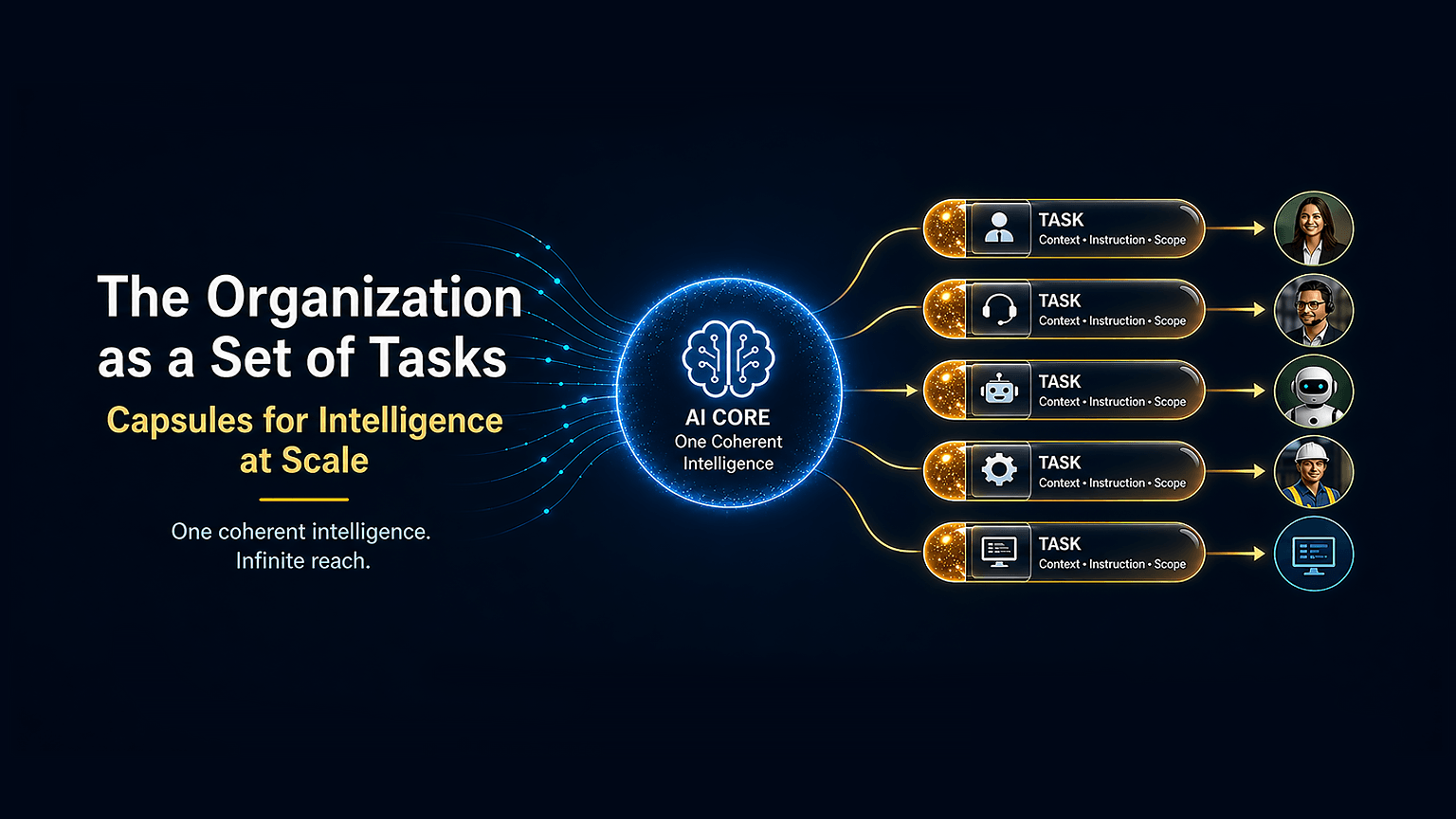
The challenge is to give intent the path that factories already use: through the operating architecture of the enterprise itself, so that the task becomes a capsule that carries intent to whoever does the work, person or agent.
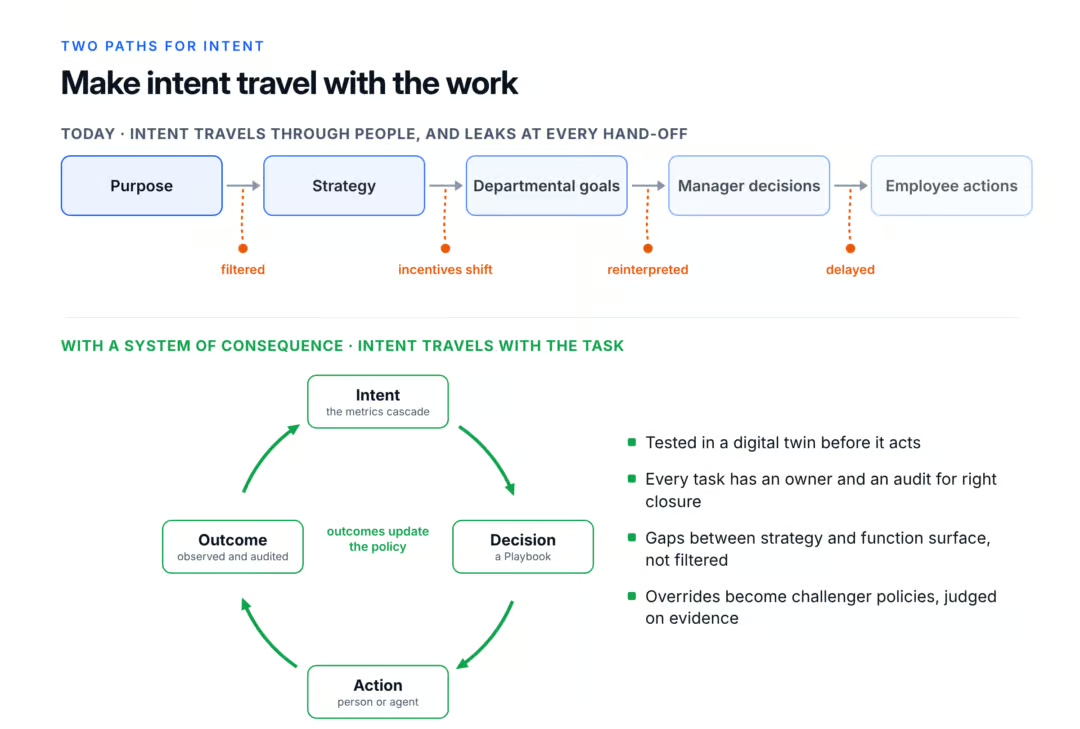
Consider renewals, the lifeblood of customer retention. Conventional systems record opportunity stages, actions, and expectations. A system of consequence would also run the policies that time and target activities for renewal, expansion, cross-sell, customer engagement, product adoption, and customer success. It would simulate alternative policies, record what sellers do, compare the resulting outcomes, and update the policies accordingly. Renewal management becomes not merely a prediction of the future but part of a system for changing it.
In a traditional hierarchy, the gap between stated policy and actual behavior is largely invisible to the principal. In the target architecture, every detection, decision, and action leaves an auditable trail.
Each of these draws on decades of OR, from simulation and control to sequential decision-making, and raises hard technical questions.
Every mechanism above makes agency visible. Visibility does not change what agents want, and computational control can itself create new agency problems. Organizational economics predicts four responses, and the system design must handle each of them.
Eugene Fama and Michael Jensen described good governance as separating decision management (initiating and implementing), from decision control (ratifying and monitoring). A policy lifecycle should make that separation continuous.
A system that rates every task-owner can feel like Taylorism with better instruments. An enterprise can reduce one form of agency loss by creating another: people become cogs in the system rather than capable participants in it. Research on algorithmic management shows that workers resist and game systems that monitor and evaluate them, and the EU AI Act treats some forms of worker task allocation and performance monitoring as high-risk.
The answer is to make the policy the primary object of control, while keeping human judgment, innovations, learning, and agency inside the loop. The system must:
This is more than a matter of acceptance. A coherent enterprise needs people who can recognize when the model is wrong, understand why it is wrong, and propose something better. Humans set purpose, define constraints, resolve the novel, and generate challengers. The objective is not to replace human agency with computational control. It is to give human judgment a better institutional memory, a better consequence model, and a faster path from insight to tested change.
The goal is therefore not human versus machine, but human judgment inside a learning system.
If intent can be made to travel with the work, AI’s value stops being a sum of saved hours. It compounds in four places.
This is the shift from agentic LLM deployments to AI-First organizations that use systems of consequence to reduce coherence loss. Enterprise intelligence, then, is not just the intelligence of individual agents scaled upward. It is the coherence and velocity of the system those agents operate in.
None of this is new theory. Jay Forrester showed in Industrial Dynamics (1961) that enterprises oscillate because of their own feedback structure. Hau Lee and his colleagues named the supply-chain version: the bullwhip effect. I have argued, with my co-authors in Business Analytics and The Analytics Asset, that decision cycles are the enterprise’s control loops, and that they are best run as tiered control loops. The obstacle was the cost of applying it enterprise-wide.
AI-First makes it possible to track and reduce coherence loss. Purpose, decisions, actions, and outcomes can be represented, tested, and learned-from as loops. The goal is not just an autonomous enterprise. It is a coherent one, intelligent and purposeful in every act.
The corporation gave capital a scalable organizational form. Separating ownership from management lets professional managers run enterprises at scale. AI, built on decades of OR, can give organizations the intelligence for sense-making, pathfinding, acting, and learning.
It used to require a bespoke OR team and a multi-year program to represent an enterprise’s purpose, state, and decisions in software, and simulate its future. Only the largest firms could afford it, typically in specific domains such as supply chains and chip fabs. In interviews with optimization practitioners, Connor Lawless, Jakob Schoeffer, and Madeleine Udell found that experienced modelers spend a lot of time on eliciting problems that stakeholders describe vaguely and incompletely, on data preparation (that some practitioners put at 70 percent of the effort), and into repeated rounds of stakeholder review. With systematic reuse, the cost of building and adapting these systems can now fall sharply. A shared semantic model and data pipelines generated from specifications carry work from one enterprise to the next, and a library of simulators and playbooks means each enterprise does not have to elicit its problem statements from scratch. LLM coding agents, hyperscale data centers, and advanced algorithms further cut cost and provide scale.
Whether the total cost of maintaining a trustworthy enterprise model is low enough remains an empirical question, but the economics have changed enough to make the opportunity newly plausible. In Jensen and Meckling’s terms, the price of oversight has fallen, so the efficient level of coherence loss has fallen with it. We believe the data pipelines, the twin, the playbooks, and the checks that keep them honest can now be built, verified, and maintained for each enterprise by a small team. A system of consequence enables reuse, and spreading costs dramatically reduces them. LLMs also matter here, twice: coding agents build the system and they help people work with the system.
Cost was not the only obstacle. Enterprise-scale planning has a mixed record. Stafford Beer’s Cybersyn did not outlast the government that commissioned it. The Planning-Programming-Budgeting System spread from Robert McNamara’s Pentagon across the US federal government in 1965 and was abandoned by 1971. Many ERP programs promised one plan for the whole firm and delivered a costly system of record. Henry Mintzberg’s diagnosis in The Rise and Fall of Strategic Planning still holds: plans fail when they are fixed in advance and cut off from the people who learn by acting. What we propose differs in one essential way. It does not replace judgment with a plan. It runs loops: policies are tested before they act, re-scored after, and replaced when a challenger does better, and human judgment is the main source of challengers. Factories and supply chains showed that a model can carry intent into execution. A system of consequence has the loops that keep that model under test. These loops handle gaps that the Lawless study described when models are built as one-off projects: assumptions kept in ad hoc notes and presentations, little tooling to track how formulation changes, and upkeep after deployment often handed off to other teams or to the client.
A basic need is for trustworthy data. Irv Lustig of INFORMS put his finger on the failure that sinks enterprise models: the source data changes underneath them. A unit of measure changes, and a data series jumps a thousandfold overnight. Documentation and verification must be part of the system, not an afterthought: an automatically generated description of every data pipeline, reconciliation at hand-off, and continual data-quality checks that flag a series the moment it breaks pattern. The intelligence layer needs the same standard: every model and playbook documented, reconciled, and checked.
This changes the work of your analytics team. When coding agents make models cheap to build, the workload moves to innovation, design, verification, and audit: deciding what to model, proving the model is right, and keeping it honest as the business changes. As one practitioner in the Lawless study warned, someone could use a flawed model, get the wrong answer, and never know it.
So here is the opportunity: build your enterprise’s system of consequence. Make purpose computable. Test every policy before it acts and audit it after. Give every decision an owner. Keep the whole thing honest as the data and the business change. Measure success not in hours saved, but in coherence loss recovered.
At RevInsight we are working on one corner of it, in revenue and go-to-market. The problem is far bigger than any one company. If you want to know how much coherence loss your enterprise is carrying, start by measuring one function. We would be glad to compare notes.
From the RevInsight blog
External sources